
Is Traveling to Tbilisi Worth It? The Digital Business Owner’s Reality Check
An honest look at lifestyle, infrastructure, and the reality of operating a digital firm from the country of Georgia.

Is Traveling to Tbilisi Worth It? A Digital Business Owner’s Reality Check
Have you ever considered traveling to the Caucasus? Let me be direct—this region is a high-contrast landscape where each city offers a completely different reality.
My name is Kaylee Tindle, and since my business and finance firm is completely digital, I have the freedom to travel extensively. I’m giving you my honest review of what it’s actually like to live in Tbilisi, Georgia. Was it worth it? Did the experience live up to the hype? And most importantly, is it the right destination for your standards? Let’s get into the facts.
The Perspective: Asset Protection & Growth
I’ve built a life of total geographic independence by helping others scale and protect what they’ve built. As a licensed wealth strategist and the founder of SWK (SuccessWithKaylee™), I specialize in asset protection, money management, and business growth strategies. My work is designed to help families and high-level professionals secure their wealth while maintaining the freedom to operate from anywhere in the world.
If you’re looking for a no-BS approach to managing your assets or scaling a digital business, I can help—book a consultation with me here. But for now, let’s get into the ground truth of living in the Georgian capital....

Where is Tbilisi? Getting Your Bearings
Before we dive into the experience, let’s get the geography straight. If you’re looking at a map, Georgia is located in the Caucasus region, sitting at the intersection of Eastern Europe and Western Asia.
To the north, Georgia is bordered by Russia, with the massive peaks of the Greater Caucasus Mountains forming a natural wall. To the south, you’ll find Turkey and Armenia, while Azerbaijan sits to the east and southeast. To the west, the country opens up to the Black Sea.
The capital, Tbilisi, is nestled in the eastern part of the country, carved into a valley along the banks of the Mtkvari River. Because it's surrounded by the Saguramo, Trialeti, and Kartli ranges, the city feels like a natural amphitheater. This strategic location has made it a historical crossroads for centuries—meaning you get a mix of ancient architecture and a modern, high-energy atmosphere that’s unique to this part of the world.
The Language: Navigating Tbilisi
When it comes to communication, Georgia has one of the most distinct linguistic identities in the world.
The official language is Georgian (Kartuli), which belongs to the Kartvelian language family. It is not Slavic, Turkic, or Indo-European—it is its own isolated branch with a unique, flowing alphabet that dates back over 1,500 years.
While Georgian is the heartbeat of the country and is woven into every street sign and menu, you’ll encounter a complex linguistic layer in Tbilisi:
English: Among the younger generation and in the tech/business hubs, English is widely spoken and high-level. You can generally navigate a digital lifestyle here without being fluent in Georgian.
Russian: Due to the country’s history, many older Georgians and those in the service industry are fluent in Russian. However, given the current geopolitical climate, English is increasingly the preferred second language for the youth.
The Script: Don’t expect to "guess" words based on Latin roots like you might in Western Europe. The Georgian script is beautiful but entirely unique—you'll want a translation app handy for the more traditional neighborhoods.

The Culture: Politeness & Perspective
Having lived in 33 countries to date, I’ve seen every side of social dynamics—from the high-intensity cursing you find in the Balkans to the more reserved cultures of Western Europe. Tbilisi, Georgia, stands out for a level of hospitality and politeness that I genuinely haven't encountered anywhere else.
The Georgian culture is built on the belief that "a guest is a gift from God." This isn't just a marketing slogan; it shows up in the everyday nature of the people:
Welcoming Nature: Whether you are in a high-end business meeting or a local market, there is a deep-seated respect and a welcoming tone to the language and social interactions.
Polite Conduct: Unlike other regions where the speech can be aggressive or filled with profanity, Georgians generally maintain a level of decorum and politeness that makes living here as a professional very seamless.
A Global Benchmark: After navigating over 30 countries, the social ease of Tbilisi is one of its strongest selling points. If you value a culture that prioritizes respect and hospitality, Georgia delivers.

The Foundation: Orthodox Christianity & Resilience
To understand the people of Georgia, you have to understand their faith. The country has been Orthodox Christian since the 4th century, making it one of the oldest Christian nations in the world.
From a perspective of historical and cultural management, the sheer resilience of this institution is impressive. Georgia survived centuries of pressure from the Roman Empire, the Ottoman Empire, and 70 years of Soviet Communism. Despite state-enforced atheism in the 20th century, Orthodox Christianity remained the bedrock of the country’s beliefs, morals, and ethics.

A Personal Commitment
This deep-rooted history and the moral stability it provides are exactly why I chose this destination for a major personal milestone. Beyond traveling here for business or lifestyle, I personally chose Tbilisi as the place to be baptized into Christian Orthodoxy. After living in 33 countries, I’ve developed a very clear lens on which cultures actually stand by their convictions. In a world that often feels spiritually diluted, the strength of the Georgian Orthodox Church is a rare find. To be baptized in a land that has defended its faith for nearly 1,700 years was a deliberate choice for me—one rooted in respect for their endurance and the clarity of their values.
How This Affects the Environment
This isn't just "history"—it is the active social fabric of Tbilisi. You will notice:
Moral Stability: These deep-seated roots contribute to the high level of personal safety and the polite, respectful social conduct I mentioned earlier.
Architectural Identity: From the 6th-century Jvari Monastery to the massive Holy Trinity Cathedral (Sameba) in Tbilisi, the skyline is a constant reminder of this endurance.
A Living Tradition: Unlike some parts of Western Europe where cathedrals are just museums, these are active community hubs central to Georgian identity.
The Legacy of King Tamar
The history of the Georgian Orthodox Church isn't just about ancient buildings; it’s about the figures who defined the nation’s strength.
During my baptism, I was given the Cross of King Tamar.

It’s a common misconception for outsiders to assume Tamar was a man. She was a woman who ruled during Georgia’s Golden Age in the 12th century. She held such immense status, power, and respect that the language itself had to adapt; she was not called a Queen Consort (Dedopali), but was instead given the title "Mepe"—the Georgian word for King.
As a woman who has built a global business and a life of total independence, I find her legacy incredibly significant. She wasn't just a figurehead; she was a brilliant strategist who expanded the empire’s borders and was eventually canonized as a saint. So, if you ever see a beautiful green cross with a ruby in the center surrounded by pearls and gold... that’s the Georgian Cross of King Tamar. Receiving her cross during my baptism was a reminder of the standard of excellence and resilience this culture expects from its leaders.

A Definitive Pivot: From the Craft to the Cross
Within the Church, I was named after Saint Catherine of Alexandria. In history, she is a titan of intellect—a woman who used high-level logic and unwavering conviction to dismantle the arguments of the most powerful pagan philosophers of her time.
For me, this naming is a marker of a total life transition. To be blunt: Before coming to Orthodoxy, I was a witch. This wasn't some casual hobby or a "new" digital venture. My background involved years in that world, and my very first online business was built on that foundation. Moving from the occult into the 1,700-year-old lineage of the Georgian Orthodox Church wasn't a "tweak" to my lifestyle—it was a complete demolition and rebuild of my personal and professional ethics.

The Standard of Saint Catherine
I chose this path because I value what is absolute and what is proven.
The Death of Subjectivity: In my past, everything was based on the "mystical" and the subjective. Today, as a licensed wealth strategist, I deal in the objective: protecting assets, managing capital, and building businesses on rock-solid foundations.
No Compromise: Saint Catherine didn't bow to the Emperor, and Georgia didn't bow to the Soviets. That's the energy I bring to my firm, SuccessWithKaylee™. I don't follow trends, and I don't offer "guru" fluff.
Why Tbilisi? There is a specific power in being baptized in a land that has spent nearly two millennia defending its borders and its faith. It was the only place that felt heavy enough to match the weight of the chapter I was closing.

The Culinary Standard: Clean Ingredients & Discipline
If you’re coming from a Western country, the first thing you’ll notice about Georgian food is the lack of "bioengineered garbage." Because I prioritize unprocessed, high-quality ingredients, Tbilisi is a massive win. The produce actually tastes like food, and the meats aren't pumped full of synthetic additives.
But if you want to understand the heartbeat of the city, you have to talk about Khinkali.
The King of Dumplings: Khinkali
Khinkali are massive, pleated dough pockets traditionally filled with spiced meat and a hot, savory broth. This isn't just a meal; it's a cultural test. If you want to look like a professional and not a tourist, there is a specific protocol: Never use a fork and knife. If you pierce the dough with a utensil, the broth spills out, and you’ve failed.
The Khinkali Protocol:
Grab the Handle: Pick up the dumpling by the "kuchi" (the doughy top knot).
The First Bite: Take a small, careful bite from the side to create an opening.
The Slurp: Drink the hot broth through that hole. Do not let a drop escape. (I'm serious)
The Finish: Eat the rest of the dumpling (the meat and thin dough).
Discard the Knot: Do not eat the thick top knot. It’s meant to stay on your plate. (Yes they will make fun of you if you eat it... trust me haha)


The Fasting Challenge
While the tourist blogs will tell you to eat the bread-and-cheese "boats" (Khachapuri) all day, I look for the nutrient-dense options that align with a high-performance lifestyle, like Pkhali (minced vegetables with walnut paste) or Mtsvadi (meat roasted over grapevines).
However, navigating this menu requires a different kind of discipline depending on when you visit. Near the end of my time in Tbilisi, it was hard not to eat these traditional foods as I was participating in fasting. In the Orthodox tradition, fasting means cutting out all meat and dairy. In a city where the smell of spiced beef and melted cheese is on every street corner, it was a true test of the conviction I found here. It forced me to find the best plant-based Georgian dishes, which actually fit my "no-garbage" dietary standards perfectly and kept my energy levels high without the bloat of processed fillers.

The 8,000-Year Asset: The Birthplace of Wine & Cha-cha
When you talk about "legacy" in Georgia, you aren't talking in decades or centuries—you are talking in millennia. Archaeological evidence confirms that Georgia is the birthplace of wine, with a history stretching back over 8,000 years.
While much of the world has industrialized and chemically altered their production, Georgia has maintained a method that is as "clean" and unprocessed as it gets.
The Qvevri Method: Ancient Tech That Still Wins
The secret to the depth and health profile of Georgian wine is the Qvevri (kway-vree). These are massive, egg-shaped clay vessels lined with beeswax, filled with crushed grapes, and buried underground to ferment at a stable, natural temperature.
The "Amber" Reality: This process creates Amber Wine. Because the white grapes ferment with their skins, the wine absorbs high levels of tannins and antioxidants—a much more robust, "living" product than the filtered white wines found in U.S. grocery stores.
Chacha: The Spirit of Georgia: You cannot talk about Georgian viticulture without mentioning Chacha. This is a potent Georgian brandy (often called "vine vodka") distilled from the "pomace"—the grape skins, seeds, and stems left over from the winemaking process. In its traditional form, it is incredibly pure, often reaching 40% to 60% ABV. It’s a staple of Georgian hospitality and a testament to the culture's "zero-waste" approach to their most sacred resource.
UNESCO Heritage: This entire method is so unique that it is officially on the UNESCO Intangible Cultural Heritage list. It’s a living museum of how humans first mastered the earth’s resources.


The Chronicles of Georgia: A Monument to Resilience
To see the sheer scale of this 8,000-year identity in one place, you have to head to the northern outskirts of Tbilisi to the Chronicles of Georgia. Often called the "Stonehenge of Tbilisi," this massive monument sits on a hill overlooking the Tbilisi Sea and is a masterclass in storytelling through architecture.
Created by the sculptor Zurab Tsereteli, the monument consists of 16 massive bronze and stone pillars, each standing over 100 feet tall.

The Architecture of History
The pillars are divided into three distinct horizontal sections that represent the foundations of the country:
The Bottom: Depicts scenes from the Bible, grounding the monument in the Orthodox faith.
The Middle: Features the kings, queens, and heroes of Georgia—including King Tamar—highlighting the military and political strength that preserved the nation.
The Top: Shows everyday Georgian life, celebrations, and customs.
Standing among those giant pillars, you feel the weight of the 4th-century foundations and the deep history we’ve discussed. It is a living reminder that a nation’s history is an ongoing project—construction on the monument actually began in 1985 and is technically still "unfinished." It is a high-altitude look at how a culture survives empires and remains standing. If you want a quiet, powerful place to reflect on the transition from a mystical past to a grounded, historical future, this is it.


All taken by Kaylee, around Tbilisi.
A Family-Oriented Foundation
Despite what you might see on social media about underground clubs or hipster cafes, the true heart of Tbilisi is profoundly family-oriented. You see it in the way the city is structured and the way people conduct themselves. This isn't a "party place" in the sense of reckless, transient energy—it is a place of deep social stability and communal respect.
What you’ll notice on the ground:
Kids are Welcomed Everywhere: In Georgia, children aren't seen as a "disturbance" to adult spaces. Whether you are at a high-end restaurant or a casual cafe, you will see families together. The culture has a genuine warmth toward children that goes far beyond polite tolerance.
Respect-Based Safety: Because the society is built on family roots and Orthodox morals, the level of personal safety is remarkably high. You can walk through most neighborhoods at 2:00 AM without the "on-edge" feeling you get in major U.S. cities. People here respect the social fabric because they are answerable to their families and their community.
The Sunday Tradition: Sundays in Tbilisi aren't for recovery; they are for the Church and the family table. You’ll see multi-generational families—grandparents, parents, and children—walking through Vake Park or gathering for a massive afternoon meal.
The "No-BS" Reality for Professionals
If you are coming here expecting a wild, anonymous "spring break" atmosphere, you are in the wrong city. While there is a nightlife scene, it is largely secondary to the country's primary value: The Sanctity of the Family. As someone who values logic and long-term stability, I found this environment incredibly productive. When a culture prioritizes its children and its elders over short-term "fun," it creates a level of moral clarity that is rare in 2026. Living in a city that actually stands for something, and protects its family values through both faith and law, provides a groundedness that allows you to focus on what actually matters: building a legacy and protecting your future.


All taken by Kaylee, around Tbilisi
The Street Animals: A Necessary Reality Check
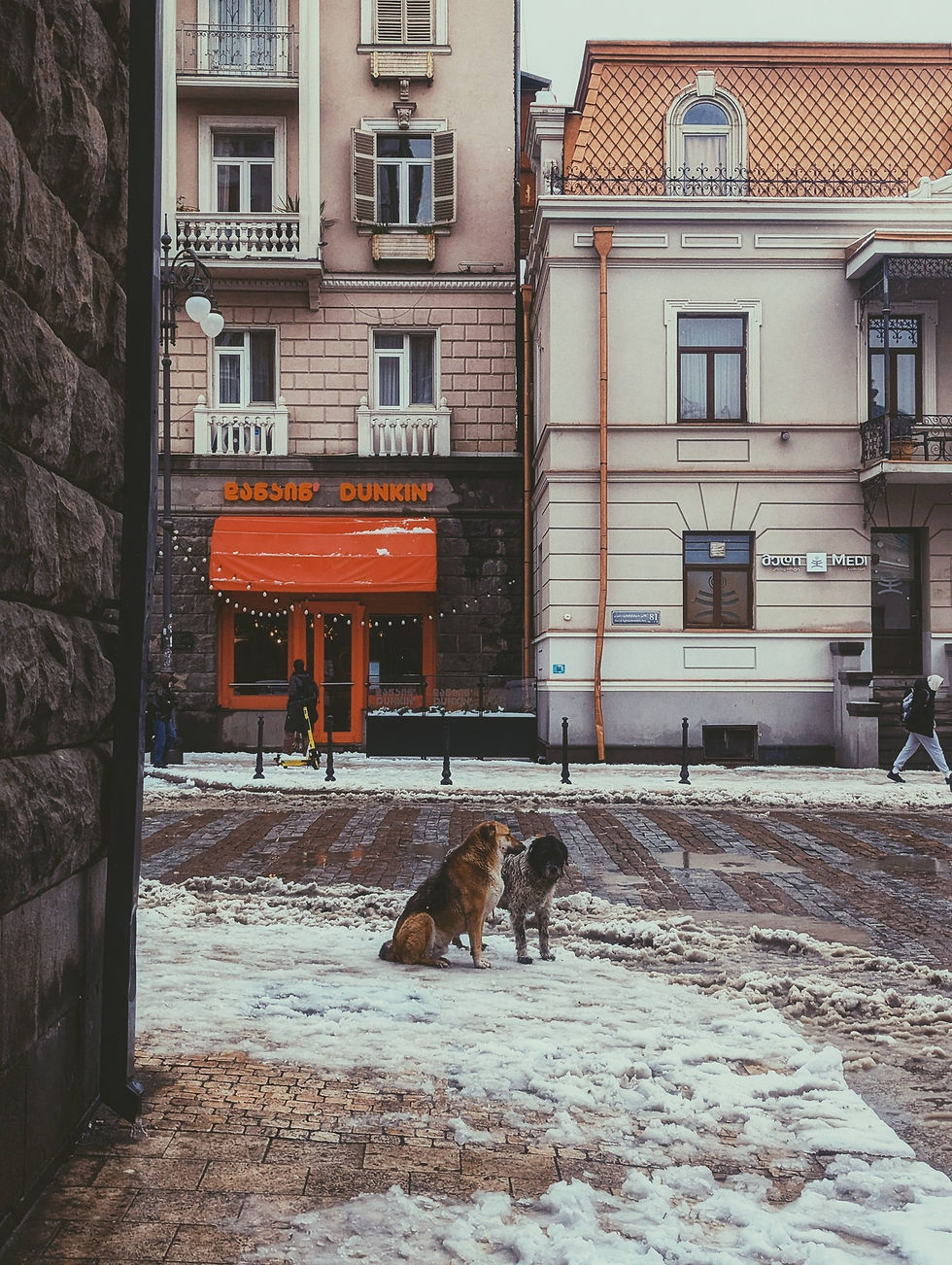
One of the most visible aspects of life in Tbilisi—and one of the few things I personally didn't like—is the sheer number of stray cats and dogs roaming the city. If you aren't used to it, seeing animals on every corner can be a bit of a shock.
However, to provide some perspective: it is not as bad as other places. Having lived in 33 countries, including places like Albania, I’ve seen much worse situations where the animal population is neglected or aggressive. In Tbilisi, the dynamic is different:
The "Yellow Tag" System: You’ll notice many of the street dogs have a bright plastic tag on their ear. This is a municipal program indicating the dog has been vaccinated, sterilized, and deemed non-aggressive. It’s a organized effort to manage the population humanely.
Community Care: Georgians are surprisingly compassionate toward these animals. It’s common to see "dog houses" built on sidewalks or bowls of food and water left outside shops. The animals are generally very docile and accustomed to people.
The "Village" Feel: Despite being a capital city, this creates a bit of a "village" atmosphere. While I’m not a fan of the stray population from a sanitation or aesthetic standpoint, the dogs here are remarkably well-behaved compared to the strays in the Balkans or parts of Southeast Asia.
What This Means for Your Visit
If you have a phobia of dogs or are used to the sterile, animal-free streets of some Western suburbs, this will be an adjustment. But if you can look past the initial surprise, you’ll see it’s just another layer of the community-oriented nature of the city. The animals are part of the social fabric here, and the city is actively working to manage them without the cruelty seen in other developing regions.


All Taken by Kaylee, around Tbilisi
The New York of the Caucasus
One of the most surprising things you’ll encounter in Tbilisi is the local fascination with New York City. Despite being thousands of miles away and rooted in ancient tradition, many Georgians look to NYC as the ultimate symbol of energy and opportunity. You’ll see it in the fashion, the influx of specialty coffee shops, and the general "hustle" of the younger generation. But for me, the connection is more than just an aesthetic trend.
Avlabari: A Glimpse of Old New York
While most tourists stay in the polished areas of the Old Town, I spent a lot of time in Avlabari, one of the city's oldest and most authentic districts. Walking through certain backstreets there gave me a distinct sense of déjà vu.
The steep, narrow streets, the red-brick foundations, and the way the buildings are crowded together with iron fire escapes and hanging balconies reminded me of Old New York—specifically parts of the Lower East Side or Brooklyn before they were fully gentrified.
The Grit and the Character: Avlabari isn't "perfect." It’s lived-in. It has that raw, unpolished energy where multi-generational families live above small, bustling markets.
The Urban Fabric: Just like the old neighborhoods of the Big Apple, there’s a sense of "organized chaos" here. You’ll find a 100-year-old bakery next to a high-end development, all connected by cobblestone paths that have seen centuries of history.
The Skyline Contrast: Standing in Avlabari and looking across the river at the modern glass of the Peace Bridge and the Narikala Fortress feels like looking from Brooklyn into Manhattan. It’s that same juxtaposition of the ancient and the hyper-modern that defines the New York spirit.
There is a reason so many Georgians feel a pull toward NYC—and why an American can feel strangely at home in the middle of Tbilisi. Both places share a "refuse to quit" attitude and a landscape that wears its history on its sleeve.


All taken by Kaylee, around Tbilisi
The Final Verdict:
After living in 33 countries and maintaining a professional career that requires absolute focus and high standards, the question is simple: Is traveling to Tbilisi worth it?
ABSOLUTELY.
If you are looking for a place that still has a soul—a place where history isn't just in a museum but is lived out in the streets, the faith, and at the family table—then you are missing out on an incredible part of the world.
Considering a trip to Tbilisi? Here’s a helpful checklist to determine if it’s the right destination for you at this stage:
Tbilisi is a Great Trip for Someone Who:
Has traveled internationally before – This isn't a "beginner" destination; it’s for those who appreciate depth over convenience.
Values Ancient History – You are walking through 4th-century foundations and an 8,000-year-old wine culture.
Prioritizes "Clean Eating" – You want food without "bioengineered garbage" and appreciate EU-standard produce.
Respects Religious Tradition – You are comfortable in a city deeply rooted in Orthodox Christianity and its customs.
Loves a High-Contrast Aesthetic – You enjoy seeing 12th-century fortresses right next to hyper-modern glass architecture.
Prefers a Family-Oriented Atmosphere – You value a city that prioritizes social stability and respect over a "party-hard" scene.
Is Ready for a Personal Transformation – You appreciate places that provide the "weight" and history to help you close old chapters.
Enjoys a "Walking City" – You love exploring the red-brick grit of Avlabari and the "Old New York" feel of the backstreets.
Is Not Easily Deterred by Strays – You can maintain perspective regarding the local street animal population.
Appreciates Authentic Craft – You’d rather drink wine from a Qvevri than a mass-produced factory bottle.
Values High-Level Safety – You want to feel comfortable walking the streets at 2:00 AM due to a strong, respect-based social fabric.
Doesn’t Mind a Language Challenge – You find the unique Georgian script and language an exciting part of the "insider" experience.
Maintains a Sense of Awareness – Like any major hub, you stay sharp and professional while navigating new terrain.
Carries Some Cash – While the city is modern, having Lari (GEL) on hand is a mechanical necessity for smaller shops and local markets.
Tbilisi is NOT a good trip for someone who:
[X] Prefers a "Sanitized" Tourist Experience – If you need every street to be perfectly polished and animal-free, the raw, red-brick grit of Avlabari will frustrate you.
[X] Has Not Internationally Traveled Before – Georgia has a deep, complex soul; it’s not a "beginner" destination for those who haven't navigated different cultures.
[X] Is Looking for a Constant "Party" Scene – This is a family-oriented city built on Orthodox traditions. If you’re looking for a 24/7 spring break atmosphere, you’re in the wrong place.
[X] Isn't Interested in History or Faith – If 4th-century foundations, the Legacy of King Tamar, and ancient churches don't move you, you’ll miss the entire point of the city.
[X] Dislikes Adapting to Local Customs – Georgia has a strong identity. If you expect them to change their social fabric to fit your Western norms, you won't enjoy your stay.
[X] Prefers "Bioengineered Garbage" – If you are addicted to highly processed, corporate fast food, the "clean," garden-to-table reality of Georgian cuisine might be a shock to your system.
[X] Has Trouble Maintaining Awareness – While it is incredibly safe, navigating a city with a unique script (Mkhedruli) and winding backstreets requires a professional level of alertness.
[X] Is Easily Offended – Georgians are direct and high-conviction people. If you prefer "soft" or overly-curated social interactions, the local "no-BS" attitude might feel abrasive.
[X] Doesn't Like Carrying Cash – While modern, the mechanical reality of local markets and smaller shops means you must have Lari (GEL) on hand.
[X] Expects a "Mystical" or "New Age" Vibe – This is a city of Absolute Truths and historical weight. If you’re looking for "guru" fluff or subjective spirituality, the grounded reality of the Georgian Church will be a wake-up call.
Recommended Tour Guides for Tbilisi
Whether you are exploring on a budget or seeking a private, high-standard experience, these are the most reliable options for navigating Georgia’s unique landscape.
Budget-Friendly Tours
Free Walking Tours in Old Tbilisi Daily tours that cover the city's 4th-century foundations, the sulfur bath district, and the narrow backstreets of the Old Town. These operate on a pay-what-you-wish basis and are the best way to get your bearings. Look for the "Tbilisi Free Walking Tour" or "GuruWalk" local guides.
Kazbegi & Military Highway Group Trips Affordable day trips that take you into the High Caucasus to see the Gergeti Trinity Church. Most of these depart from the Avlabari Metro area and are significantly cheaper than hiring a private driver for a solo mountain run.
GetYourGuide & Klook Apps These apps are the most efficient tools for booking vetted, low-cost day trips to UNESCO sites like Mtskheta or the cave city of Uplistsikhe. They take the guesswork out of pricing and scheduling.
Small Group Wine Tastings Companies like Gamarjoba Georgia or Budget Georgia run high-value trips to the Kakheti region that include multiple wine tastings and traditional bread-making demonstrations for a fixed, transparent price.
Luxury & Private Experiences
Private Custom Wine Tours (Kakheti) For a serious look at 8,000-year-old Qvevri traditions, book a private car to high-end estates like Château Mukhrani or Schuchmann Wines. These offer quiet, sophisticated tastings and gourmet "Supra" (feast) experiences away from the tour bus crowds.
Artisans of Leisure – Georgia The gold standard for luxury travel. They provide fully tailored itineraries with VIP airport assistance, private drivers, and stays at the city's premier hotels like the Paragraph Freedom Square.
Private Historical & Religious Pilgrimages If you want a deep, technical explanation of the Orthodox faith and its impact on Georgian history, hire a specialized private guide through agencies like Advantour. They focus on the theological and architectural significance of the 4th-century sites.
Helicopter Charters to the Caucasus To see the sheer scale of the mountains and remote monasteries without the long drive, private helicopter tours can be arranged departing from Gudauri or Tbilisi. This is the ultimate way to view the intersection of the ancient and the infinite.
Secure Your Legacy with SuccessWithKaylee™
Success isn’t accidental, it’s engineered. If you value the same discipline, tradition, and high standards I’ve described here in Georgia, let’s apply that same "no-BS" approach to your wealth strategy.
Whether you are looking for business formation, building high-limit corporate credit, or protecting your future with Indexed Universal Life (IUL) and annuities, I provide the strategic roadmap to get you there.
Stop guessing with your financial future and start building on a solid foundation.
Book your 1-on-1 strategy session with SuccessWithKaylee™ and let’s get to work.


